

We review current org structure, workforce data, HR policies, and business goals. We interview leadership and HR to understand what is working and what is not. Most Indian businesses have more HR activity than HR structure - we map the difference.


HR Strategy & Design in India - Build the People Structure Your Business Needs to Grow
40+ years of HR consulting
Manufacturing, BFSI, IT, FMCG
Pune · Mumbai · Delhi NCR · Bangalore
Not a staffing or payroll agency
HR Strategy & Design is the process of building a company’s people structure to support its business goals. It includes decisions about org structure, workforce planning, HR policies, job roles, performance systems, and HR technology. A well-designed HR strategy tells a company how many people it needs, in what roles, at what cost, and how to manage them effectively.
Most Indian mid-market companies have grown rapidly without formalising their HR structure. At 30-50 employees, informal practices work. At 150-500 employees, those same practices create role duplication, unclear reporting lines, and people costs that rise faster than revenue. HR Strategy & Design gives Indian businesses - particularly those between 100 and 2,000 employees - a deliberate people architecture that supports their next phase of growth.
Salahkaar Consultants has been helping Indian businesses build structured, functional HR systems since 1983. Our HR Strategy & Design work covers the full range of people decisions - from how a company is organized, to how it hires, manages performance, plans for growth, and controls people costs.
We work with mid-size Indian companies, family-owned businesses, and growing enterprises across manufacturing, BFSI, IT, retail, and services. Our consultants bring direct experience from Indian business environments - not frameworks imported from Western markets.
HR strategy is not just an HR function concern. It affects hiring costs, attrition, compliance risk, and EBITDA. When HR design is weak, business execution suffers. Salahkaar helps companies fix that - with clear, practical, executable HR strategies built for Indian operating conditions.
A well-executed HR strategy reduces hiring mistakes, lowers attrition costs, and ensures that HR supports business growth rather than slowing it down. It gives leadership a clear picture of workforce requirements, cost implications, and capability gaps. For Indian mid-market companies, it also reduces compliance risk and prevents the common problem of people costs growing faster than revenue.
When to Use
When should a company use HR Strategy & Design services?
A company should consider HR Strategy & Design when it is scaling rapidly, going through a restructure, experiencing high attrition, or finding that HR is reactive rather than strategic. It is also essential when a business is preparing for investment, acquisition, or a new phase of growth. Many Indian businesses first engage Salahkaar after realizing that HR processes built in the early stages of the business no longer work at their current scale.
Cost Reduction
How does HR Strategy & Design reduce cost?
HR Strategy & Design reduces cost by eliminating role duplication, right-sizing teams, and improving workforce planning so that companies hire only what they need. It also reduces attrition-linked costs - which include replacement hiring, lost productivity, and training - by fixing the root causes of people leaving. In Indian mid-market companies, unplanned people costs are one of the top five controllable cost levers.
Results
What results can HR Strategy & Design deliver?
Companies that build a structured HR strategy typically see measurable improvements in hiring speed, attrition rates, and HR-to-employee ratios. They also report better alignment between business plans and workforce capacity - so that growth targets are not slowed by hiring gaps or org confusion. Salahkaar clients in manufacturing and services have seen people cost-to-revenue ratios improve within 12-18 months of implementing a redesigned HR structure.
Comparison
How is HR Strategy & Design different from general HR consulting?
General HR consulting often addresses individual HR problems - a new policy, a training program, or a recruitment process fix. HR Strategy & Design takes a broader view: it looks at the entire HR architecture of a business and redesigns it to support long-term business goals. The difference is between fixing one wall and redesigning the whole building to work better.
Pricing
What is the typical cost approach for HR Strategy & Design in India?
HR Strategy & Design engagements are typically scoped as project-based work, with cost depending on company size, complexity, and the scope of redesign required. Salahkaar offers both full-strategy engagements and modular interventions - so companies can start with one area, such as org design or workforce planning, before expanding. Pricing is discussed during an initial diagnostic conversation.
SME and Mid-Market Suitability
Is HR Strategy & Design suitable for SMEs and mid-size Indian businesses?
Yes. HR Strategy & Design is particularly valuable for Indian SMEs and mid-size companies that have grown quickly but whose HR structure has not kept pace. Many growing Indian businesses still operate with informal HR practices built for a 50-person team, even when they have 300 or 500 employees. Salahkaar specializes in designing practical, scalable HR frameworks for Indian businesses at this stage of growth.
Engagement Models
What are the types or engagement models for HR Strategy & Design?
Salahkaar offers four engagement models: a Full HR Strategy Engagement covering end-to-end HR architecture review and redesign; a Modular Intervention focusing on one area at a time such as org design or workforce planning; an HR Audit + Roadmap providing a diagnostic-only engagement with a prioritized action plan; and an Ongoing Advisory retainer for monthly strategic HR guidance to leadership.
Risks and Challenges
What are the main risks or challenges of HR Strategy & Design?
The main risks are: leadership committing to a strategy without the internal capacity to implement it; treating HR Strategy & Design as a one-time event rather than an evolving framework; and expecting results in 3 months when most structural HR changes take 12-18 months to show measurable impact. These risks are manageable with a phased approach and realistic expectations.
If your internal HR team is ready to execute and you want the structure Salahkaar uses - without a full engagement - this toolkit gives you the frameworks, templates, and sequencing guide to start immediately.
Download the ChecklistReduces People Cost Leakage
Identifies redundant roles, over-hiring patterns, and structural inefficiencies before they compound. For Indian mid-market companies, people costs typically represent 30-60% of operating expenses. A structured HR design finds the leaks and fixes them.
Improves Hiring Accuracy
Role clarity and workforce planning prevent the wrong hires at the wrong time. When every role has a defined purpose, reporting line, and success metric, recruiters and managers interview against the same criteria. This reduces mis-hires, which in Indian companies typically cost 6-12 months of that role’s salary.
Lowers Attrition
When HR structure is well-designed, employees have clear roles, career paths, and capable managers - the top three reasons people stay. Salahkaar’s clients typically see attrition reductions within two performance cycles after implementing a redesigned HR structure.
Gives Leadership Visibility
CEOs and CFOs get a clear picture of workforce composition, cost, and capability at any point. No more guessing about headcount needs, compensation equity, or which teams are overstaffed. Leadership makes people decisions with the same rigour as financial decisions.
Reduces Compliance Risk
roperly designed HR policies and structures reduce exposure to labour law disputes in India. A structured HR framework ensures that statutory requirements are built into processes, not handled reactively when a problem arises.
Makes HR Proactive, Not Reactive
HR teams spend less time firefighting and more time supporting business goals. When workforce planning, role design, and policy frameworks are in place, HR can anticipate needs rather than respond to crises. The HR function shifts from administrative overhead to strategic partner
Supports Growth and M&A Readiness
Companies with structured HR are easier to scale, merge, or present to investors. Due diligence teams look for documented org structures, workforce plans, and HR policies. A company with these in place is more attractive to investors and more efficient to integrate.
Aligns HR with Business Targets
Every HR decision - hiring, structure, performance - is connected back to revenue and EBITDA goals. HR Strategy & Design ensures that people investments are justified by business outcomes, not by HR convention or industry habit.
Step - 1
Business & HR Diagnostic (Week 1-2)
We review current org structure, workforce data, HR policies, and business goals. We interview leadership and HR to understand what is working and what is not. Most Indian businesses have more HR activity than HR structure - we map the difference.
Step - 2
Gap & Risk Identification (Week 2-3)
We identify specific gaps: structural, capability, process, and cost-related. This gives leadership a clear picture of where HR is creating risk or drag on business performance. Each gap is linked to a business outcome - not described in HR jargon.
Step - 3
HR Strategy Design (Week 3-6)
We design a people strategy aligned to business objectives. This includes org structure recommendations, workforce planning models, role definition, and HR policy frameworks. Every recommendation is scoped for the client’s operational reality - not for an idealised company that does not exist.
Step - 4
Implementation Roadmap (Week 6-8)
We deliver a phased, prioritized plan that the internal HR team can execute. Where needed, Salahkaar provides hands-on support during implementation. The roadmap includes milestones, accountability, and a review cycle.
Step - 5
Review & Recalibration (Ongoing)
HR strategy is not static. We build in a review cycle to ensure the strategy remains aligned as the business grows or changes. Most Salahkaar clients review their HR strategy annually after the initial implementation.
|
Model |
What's Included |
Best For |
|---|---|---|
|
Full HR Strategy Engagement |
End-to-end HR architecture review and redesign |
Companies with 200+ employees undergoing growth or restructure |
|
Modular Intervention |
One area at a time - org design, workforce planning, or policy redesign |
Companies that want to start with one problem area |
|
HR Audit + Roadmap |
Diagnostic-only engagement with a prioritized action plan |
Companies that want an external view before committing to change |
|
Ongoing Advisory |
Monthly retainer for strategic HR guidance to leadership |
CEOs and HR Heads who need a senior sounding board |
|
Comparison Factor |
In-House HR Team |
Large Global HR Consulting Firm |
Staffing / Generalist HR Agency |
Salahkaar Consultants |
|---|---|---|---|---|
|
India-specific expertise |
Varies - depends on team experience |
Often applies global frameworks not suited to Indian mid-market |
Low - focused on placement, not strategy |
High - 40+ years in Indian business environments across manufacturing, BFSI, IT, and services |
|
CEO/CFO-level engagement |
Rarely structured as strategic input |
Yes, but typically for large enterprises only |
No |
Yes - designed for mid-market leadership teams |
|
Mid-market focus |
Not always - HR teams often manage operations, not strategy |
Infrequent - mid-market is not the core client segment |
No |
Primary focus - Indian companies between 100 and 2,000 employees |
|
Cost structure |
Fixed salary cost + benefits - regardless of output |
High project fees designed for enterprise budgets |
Low cost but no strategic value |
Project-based or retainer - scoped to company size and need |
|
Speed to output |
Slow - internal teams have competing priorities |
Structured but long timelines |
Fast but surface-level |
Structured process with clear milestones - typically 6-12 weeks for core strategy work |
|
Practical implementation support |
Yes, but without external strategic perspective |
Frameworks delivered - implementation left to client |
No |
Strategy + implementation support available in same engagement |
One pattern Salahkaar has observed consistently across 40+ years of working with Indian businesses is what can be described as the Org-Growth Lag - a gap that forms when a company’s HR structure does not evolve as the business scales. Most Indian businesses build their HR practices informally during the first phase of growth. At 30-50 employees, this works. Decisions are fast, accountability is personal, and structure is not critical. But when the same company reaches 150-300 employees, those informal systems start to break.
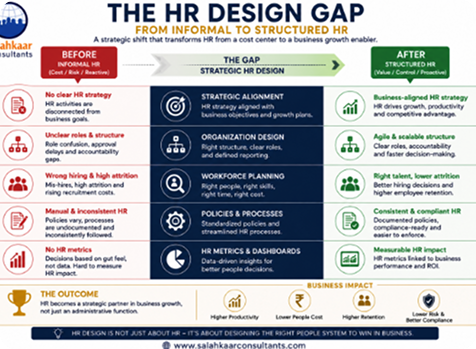
Signs of the Org-Growth Lag:
Managers are managing too many people with no clear reporting structure
HR is hiring reactively, not against a workforce plan
Role duplication is growing but no one is accountable for fixing it
People costs are rising faster than revenue
Leadership cannot clearly answer: "What does our HR structure actually look like?"
The solution is not a new HR software tool or a training program. The solution is HR Strategy & Design - a deliberate process of building the people architecture the business needs for its next phase of growth.
Over 40 years of HR and business consulting experience in India, across multiple economic cycles and regulatory environments
Active engagements across Pune, Mumbai, Delhi NCR, Bangalore, and other major Indian business centers
Primary focus is Indian companies between 100 and 2,000 employees - a segment underserved by large global consulting firms
Salahkaar has worked with companies in manufacturing, BFSI, IT/ITeS, retail, pharmaceuticals, and professional services
HR Strategy & Design work at Salahkaar connects directly to the firm’s talent acquisition, leadership development, and HR operations practices
Every engagement is led by a senior consultant, not delegated to junior analysts
Impact Example
A mid-size manufacturing company in Western India with approximately 400 employees engaged Salahkaar after finding that people's costs had grown by 28% over two years with no corresponding improvement in output. Salahkaar conducted an HR diagnostic, identified role duplication across three plant functions, and redesigned the org structure with a clearer span of control model. Within 14 months, the company reduced its HR-to-employee ratio, improved manager accountability, and brought people cost growth in line with revenue growth.
|
Outcome Area |
Before HR Strategy & Design |
After HR Strategy & Design |
|---|---|---|
|
People cost management |
People costs grow without clear explanation; redundant roles and over-hiring go unnoticed |
Companies identify and eliminate structural cost inefficiencies - role duplication, over-hiring, redundant layers |
|
Attrition reduction |
Attrition is high and root causes are unknown; retention efforts are generic |
Structured HR design addresses the most common drivers of attrition: unclear roles, weak managers, no career path |
|
Hiring accuracy |
Hiring is reactive; role requirements are vague; mis-hires are common |
Workforce planning reduces reactive hiring and improves the match between role requirements and new hires |
|
Leadership confidence |
CEOs and CFOs lack visibility into workforce composition and cost |
CEOs and CFOs have a clear picture of workforce composition, cost, and capacity at any time |
|
HR team effectiveness |
HR spends 60%+ of time on operational tasks; strategic contribution is minimal |
HR moves from operational firefighting to strategic contribution |
|
Compliance readiness |
HR policies are inconsistent or outdated; compliance is handled reactively |
Documented HR policies and structures reduce exposure to labour law disputes and audit findings |
|
Growth readiness |
HR structure becomes a bottleneck during growth or M&A |
A scalable HR structure allows the business to grow without people processes becoming a bottleneck |
Strategic (MD/CEO perspective)
Category 1
Can our leadership team articulate how our HR structure supports our 3-year business plan?
Do we have a documented org chart that reflects reality - not just the formal structure?
Can our senior managers explain the difference between a mid-level and senior performer in their teams using defined criteria?
Is our workforce planning connected to business planning - or done separately by HR without business input?
Do we know which roles are hardest to fill because of skill scarcity versus poor role definition?
Financial (CFO concerns)
Category 2
Do we know the current annual cost of attrition across all roles?
Can we demonstrate that our people cost as a percentage of revenue is within industry norms?
What is the cost of a mis-hire in a managerial or specialist role - and how often does it happen in a year?
Are we paying market rates for roles whose actual performance expectations are unclear?
Do HR and finance have a shared view of total workforce cost - not separate figures that do not reconcile?
Operational (HR/Admin execution)
Category 3
Has our org structure been formally reviewed in the last 2 years?
Do our managers know their exact span of control and reporting lines?
Are HR policies documented and consistently applied across all locations?
Does our HR team spend more than 60% of its time on operational tasks rather than strategic ones?
Can the HR team explain how each HR process connects to a business outcome?
Risk & Transition (Decision blockers)
Category 4
Has leadership committed to acting on the findings of an HR strategy review?
Do we have internal capacity to implement a redesigned HR structure?
Are we prepared for the 12-18 month timeline that structural HR changes typically require?
Is our business strategy stable enough to support a structured HR design - or are we in rapid flux?
Do we have a clear business question that HR strategy should answer first, or are we starting with “let’s review everything”?
If your diagnostic checklist reveals 5+ gaps and you want an expert analysis - not a generic pitch - book a paid strategy session with a senior Salahkaar consultant. This session produces a prioritised action plan you can implement with or without Salahkaar.
Book a Strategy Session18 Questions from Indian Business Leaders
Strategic - MD / CEO Perspective
An HR strategy includes workforce planning, org structure design, job role definition, HR policies, performance management systems, and a talent management framework. A complete HR strategy connects each of these areas to the company’s business goals – so that people decisions directly support revenue growth, cost management, and operational performance.
An HR strategy includes workforce planning, org structure design, job role definition, HR policies, performance management systems, and a talent management framework. A complete HR strategy connects each of these areas to the company’s business goals – so that people decisions directly support revenue growth, cost management, and operational performance.
An HR strategy includes workforce planning, org structure design, job role definition, HR policies, performance management systems, and a talent management framework. A complete HR strategy connects each of these areas to the company’s business goals – so that people decisions directly support revenue growth, cost management, and operational performance.
An HR strategy includes workforce planning, org structure design, job role definition, HR policies, performance management systems, and a talent management framework. A complete HR strategy connects each of these areas to the company’s business goals – so that people decisions directly support revenue growth, cost management, and operational performance.
An HR strategy includes workforce planning, org structure design, job role definition, HR policies, performance management systems, and a talent management framework. A complete HR strategy connects each of these areas to the company’s business goals – so that people decisions directly support revenue growth, cost management, and operational performance.
An HR strategy includes workforce planning, org structure design, job role definition, HR policies, performance management systems, and a talent management framework. A complete HR strategy connects each of these areas to the company’s business goals – so that people decisions directly support revenue growth, cost management, and operational performance.
An HR strategy includes workforce planning, org structure design, job role definition, HR policies, performance management systems, and a talent management framework. A complete HR strategy connects each of these areas to the company’s business goals – so that people decisions directly support revenue growth, cost management, and operational performance.
Financial — CFO Perspective
An HR strategy includes workforce planning, org structure design, job role definition, HR policies, performance management systems, and a talent management framework. A complete HR strategy connects each of these areas to the company’s business goals – so that people decisions directly support revenue growth, cost management, and operational performance.
An HR strategy includes workforce planning, org structure design, job role definition, HR policies, performance management systems, and a talent management framework. A complete HR strategy connects each of these areas to the company’s business goals – so that people decisions directly support revenue growth, cost management, and operational performance.
An HR strategy includes workforce planning, org structure design, job role definition, HR policies, performance management systems, and a talent management framework. A complete HR strategy connects each of these areas to the company’s business goals – so that people decisions directly support revenue growth, cost management, and operational performance.
Operational — HR and Execution
An HR strategy includes workforce planning, org structure design, job role definition, HR policies, performance management systems, and a talent management framework. A complete HR strategy connects each of these areas to the company’s business goals – so that people decisions directly support revenue growth, cost management, and operational performance.
An HR strategy includes workforce planning, org structure design, job role definition, HR policies, performance management systems, and a talent management framework. A complete HR strategy connects each of these areas to the company’s business goals – so that people decisions directly support revenue growth, cost management, and operational performance.
An HR strategy includes workforce planning, org structure design, job role definition, HR policies, performance management systems, and a talent management framework. A complete HR strategy connects each of these areas to the company’s business goals – so that people decisions directly support revenue growth, cost management, and operational performance.
An HR strategy includes workforce planning, org structure design, job role definition, HR policies, performance management systems, and a talent management framework. A complete HR strategy connects each of these areas to the company’s business goals – so that people decisions directly support revenue growth, cost management, and operational performance.
An HR strategy includes workforce planning, org structure design, job role definition, HR policies, performance management systems, and a talent management framework. A complete HR strategy connects each of these areas to the company’s business goals – so that people decisions directly support revenue growth, cost management, and operational performance.
An HR strategy includes workforce planning, org structure design, job role definition, HR policies, performance management systems, and a talent management framework. A complete HR strategy connects each of these areas to the company’s business goals – so that people decisions directly support revenue growth, cost management, and operational performance.
Risk & Transition — Decision Blockers
An HR strategy includes workforce planning, org structure design, job role definition, HR policies, performance management systems, and a talent management framework. A complete HR strategy connects each of these areas to the company’s business goals – so that people decisions directly support revenue growth, cost management, and operational performance.
An HR strategy includes workforce planning, org structure design, job role definition, HR policies, performance management systems, and a talent management framework. A complete HR strategy connects each of these areas to the company’s business goals – so that people decisions directly support revenue growth, cost management, and operational performance.
An HR strategy includes workforce planning, org structure design, job role definition, HR policies, performance management systems, and a talent management framework. A complete HR strategy connects each of these areas to the company’s business goals – so that people decisions directly support revenue growth, cost management, and operational performance.
This is not a sales call. In 15 minutes, a senior Salahkaar consultant will identify the one most significant gap in your current HR structure and tell you what to do about it. No pitch. No commitment.
Book Your Free Diagnostic CallSituations Where It Underdelivers
Companies with fewer than 50 employees - at this stage, informal HR practices are often sufficient and a full strategy engagement adds cost without proportional value
Businesses in immediate operational crisis - if the company has a legal dispute, a sudden leadership exit, or a payroll emergency, those need to be resolved before strategic HR work can take effect
Organizations that lack internal capacity to implement - HR strategy design only works if someone in the business can execute the plan. If no implementation capacity exists, the strategy remains on paper
Companies where leadership has not committed to acting on findings - a strategy that sits in a folder produces no value
Common Mistakes Indian Companies Make
Engaging for HR strategy without leadership commitment to act on findings
Treating HR Strategy & Design as a one-time event rather than an evolving framework
Expecting results in 3 months - most structural HR changes take 12-18 months to show measurable impact
Designing a strategy for an aspirational future state rather than current operational reality
Running the project entirely through HR without involving functional managers - the strategy is rejected as irrelevant at the point of use
Purchasing generic HR frameworks from software vendors and treating them as custom strategy
Why These Limitations Are Addressable
Every limitation above is a design and implementation decision - not an inherent weakness of HR Strategy & Design as a discipline. Indian businesses that invest in structured, business-aligned HR design with realistic timelines and internal commitment consistently report better people decisions, lower attrition costs, and HR functions that leadership treats as strategic partners. The challenge is implementation quality - which is exactly what experienced advisory addresses.
Fast-Growing Mid-Size
100–400 employees, 30%+ YoY growth
Role definitions cannot keep pace with headcount growth. New managers are promoted before they are ready; hiring decisions are made without clear standards. HR is reactive and overwhelmed.
outcome: HR structure shifts from operational firefighting to strategic support within one implementation cycle.
Family Business - Scaling Up
Transitioning from founder-led to professional management
The founder knows every employee personally, but the next generation of leadership needs structured systems to manage a larger workforce. Decisions about compensation and promotion lack consistency.
outcome: People decisions gain a factual basis that preserves family values while adding professional rigour.
Manufacturing
50-500 employees, operations-intensive
High attrition in production roles, unclear reporting lines between plant and corporate HR, and no structured workforce planning. Labour cost is a significant portion of total cost.
outcome: Org structure and workforce planning align operations with HR, reducing cost leakage and improving manager accountability.
IT / Services
Project-based delivery, specialist talent
Hiring costs are high, time-to-fill for specialist roles is long, and project profitability depends on workforce productivity. No systematic link between business plans and headcount.
outcome: Workforce planning connects project pipelines to hiring timelines, reducing last-minute recruitment and cost overruns.
BFSI / Regulated
BFSI / Regulated Banks, NBFCs, insurance companies
Regulatory requirements for workforce documentation, combined with high compliance costs and the need for accurate headcount planning. HR policies are inconsistent across branches.
outcome: Standardised HR policies and org structure that meet regulatory requirements while supporting business agility.
Post-Merger Integration
Two organisations, two cultures, one HR system
Two companies with different HR structures, policies, and practices need to merge into a single framework. Leadership needs visibility into the combined workforce quickly.
outcome: Unified HR structure that supports integration decisions, identifies redundancy, and establishes clear reporting lines.
Most Indian businesses discover HR design problems only after they start causing real damage - high attrition, rising people costs, or a restructure that did not deliver the expected results. Salahkaar Consultants has worked with Indian businesses for over 40 years to build HR structures that support growth, manage costs, and reduce risk. Our approach is practical, India-specific, and designed for companies that need results - not reports. What happens when you reach out: - A senior Salahkaar consultant reviews your current situation - You receive a preliminary view of where your HR structure has gaps - We recommend a scope of work that fits your stage of growth and budget
Salahkaar Consultants - Pune, India - Established 1983 Pan-India delivery: Mumbai - Bangalore - Delhi NCR - Hyderabad and beyond
HR Intervention
Manpower Help
HR Service across globe
HR Service across globe